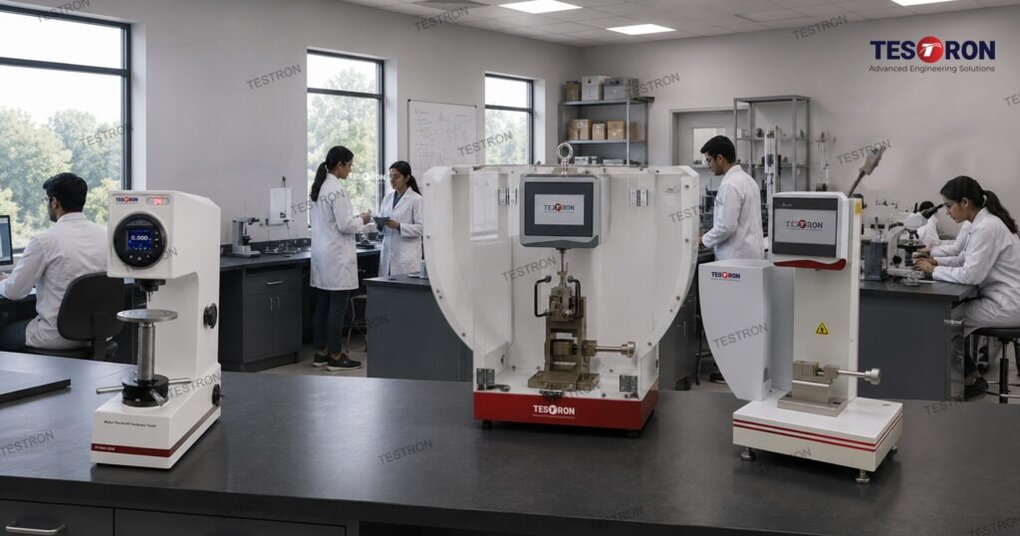
In this blog, you can discover core operational mechanics, global standardization benchmarks, and specialized laboratory deployment strategies engineered to optimize material selection for your institutional benefits.
Beyond the Textbooks: Why Dynamic Impact and Surface Resistance Rule Material Science
Students require something that works for upscaling their practical knowledge. Instead of sticking with textbook guidance, it’s time for universities to explore more about the practical solutions to teach future engineers, material innovators, and laboratory professionals with the finest material testing equipment.
So, choosing the right analytical framework is critical to preventing premature failure in real-world environments. For those who want to bring the impact testing machine or hardness testing machine, it’s important to understand the uniqueness of these tools first.
Remember, both of them can analyze how a raw substance reacts to radically different stress timelines.
Let’s understand how these machines become the backbone of modern global infrastructure and quality control. Connect with our global engineering desk today!
Defining the Pillars of Material Testing Equipment
Engineers rely on specialized hardware to apply controlled forces. Let’s discover more about the impact tester and hardness tester, designed by Testron and effective for students.
The Impact Testing Framework
An impact test machine determines a material’s toughness, ductility, and brittleness. To do so, the operator must subject a specimen to a high-velocity, dynamic kinetic force.
The primary objective of an impact tester machine is to measure the precise amount of kinetic energy absorbed by a specimen during a high-speed structural failure event.
Key characteristics of this impact strength testing machine include:
- Dynamic Force Application
- Energy Measurement
- Fracture Characterization
- Stress Concentrations
The Hardness Testing Framework
A hardness tester machine evaluates a material’s localized resistance. It starts with permanent plastic deformation, scratching, or continuous indentation. A hardness test machine applies a slow, tightly monitored static force through a standardized indenter
Crucial elements of the hardness framework include:
- Static Force Application
- Microscopic Penetration Depth
- Non-Destructive Tendencies
- Proportional Yield Strength
Share your engineering curriculum requirements with us and explore more about the EDP campaign from the certified hardness testing machine manufacturer and impact testing machine manufacturer now!
Deciphering the Impact Testing Machine: Charpy vs. Izod
While both utilize a swinging pendulum arm to break a specimen, they have unique working abilities. The mechanics of dynamic fracture are divided into two structural testing arrangements.
The Charpy Impact Testing Machine
Testron Group charpy impact tester machines are designed with a rigid dual-column or single-column bench-top structure.
Core technical highlights of the charpy impact tester machine configuration include:
- Active mechanical clamping forces acting upon the sides.
- Apply on the center of the specimen
- Useful for testing metals, heavy structural alloys, and forged components
- Perfect for sub-zero environmental chamber testing
The Izod Impact Testing Machine
Testron Group’s specialized izod impact tester provides interchangeable energy capacities. These instruments are integrated with touchscreen and other features for advanced impact testing.
Core technical highlights of the Izod configuration include:
- Vertical orientation of the sample
- Hitting the notched face of the sample at a precisely calibrated distance
- Best for plastics, polymers, electronics housings, and composite material testing
- Requires consistent gripping torque
Remember, utilizing a multi-functional charpy izod impact testing machine provides an ideal solution. The TT-IC22/50D, from Testron, combines both cantilever (Izod) and simply supported beam (Charpy) configurations.
Want more details on the izod and charpy impact test machine? Request a live virtual laboratory demonstration from our verified impact testing machine suppliers now!
Mastering the Hardness Testing Machine: Manual vs. Motorized Rockwell
The classic Rockwell measurement technique avoids human error. On the other hand, it also allows engineers to quickly gauge the hardening characteristics of materials. Let’s discover what else can students get from advanced and motorized hardness testing machines:
The Mechanics of Rockwell Penetration
A rockwell hardness testing machine establishes material resistance. The device can measure the residual depth of an impression. The process initiates with a minor test force. It uses either a 120° Rockwell diamond indenter or a 1.588mm steel ball indenter.
The Rockwell cycle follows a clear, structured sequence:
- Preloading (Minor Load)
- Main Loading (Major Load)
- Dwell Period
- Unloading and Measurement
The TT-RHA Series Manual rockwell hardness test machine operates via a traditional mechanical layout. However, the motorized rockwell hardness testing machine, TT-MRH Series, automates the loading, dwell, and unloading cycle. It is perfect for meticulous quality control environments requiring digital precision up to 0.1HR.
When dealing with massive structural assemblies, engineers utilize a portable hardness testing machine.
Schedule a professional alignment with our hardness testing machine supplier now to get more insights about the hardness testing machine in this EDP campaign!
Conclusion
For any lab, both impact and hardness testing platforms are essential. While a charpy impact test machine reveals whether a structural bridge beam or an automotive component can withstand force, a rockwell hardness test machine ensures the sample can resist ongoing wear and deformation.
Ensure that future engineering work rests on a foundation of verified, repeatable data. Join Testron and grab all the benefits and extended features given by Testron during the EDP campaign!
FAQs
- Exclusive academic discounts
- Additional spare parts
- Comprehensive technical training certificates
- An extended warranty of up to 5 years
- Free engineering laboratory installations
- A 120° diamond indenter
- A 1.588 mm steel ball indenter
- Multiple flat and V-shaped workbenches
- Calibrated Rockwell hardness blocks