This comprehensive guide provides a strategic analysis of open versus closed cup testing methodologies, helping industrial laboratories confidently choose the right flash point tester in Brazil for 2026.
Ready to eliminate compliance guesswork? Chat directly with our local Brazilian laboratory engineers on WhatsApp right now!
The Spark of Precision: Navigating Brazil’s Regulatory Shifts in 2026
The work of precision is always on the rise, and it is evolving the Brazilian market. Choosing the right flash point tester in Brazil is no longer just about buying a piece of laboratory hardware. This is about setting higher standards for the workforce and aligning with the international regulations of 2026.
Selecting between open and closed cup methodologies dictates your accuracy, safety, and international compliance. Whether you are refining biofuels in São Paulo or testing lubricants in Rio de Janeiro, having the best flash point testing machine can ease the work.
Time to decide which flash point testing equipment you should buy from Testron. Request a free product demo and click here to secure your itemized, obligation-free quote within 24 hours.
Navigating Industry Standards: ASTM, ISO, and ABNT Compliance in Brazil
For Brazilian industrial laboratories, regulatory compliance is non-negotiable. Investing in a compliant flash point testing instrument keeps your operations legally sound and ensures your test data is accepted by global trade partners.
ASTM D92: The Open Cup Benchmarks
These standards dictate the protocol for the Cleveland open cup flash point tester.
ASTM D93 & ISO 2719: The Pensky-Martens Flash Point Tester closed cup Standard
This is arguably the most critical standard for the Brazilian energy sector, governing the use of Pensky-Martens closed cup equipment.
Comment “STANDARDS” below, and the flash point tester manufacturer will send you a customized compliance matrix directly to your inbox!
Product Breakdown: Testron Group’s Leading Lineup for 2026
A dependable flash point tester supplier is paramount to securing durable, high-precision laboratory hardware. With Testron, users get robust, state-of-the-art petroleum testing equipment.
Below is a comprehensive breakdown of the specific flash point testing instruments available to transform your facility’s testing throughput and data integrity.
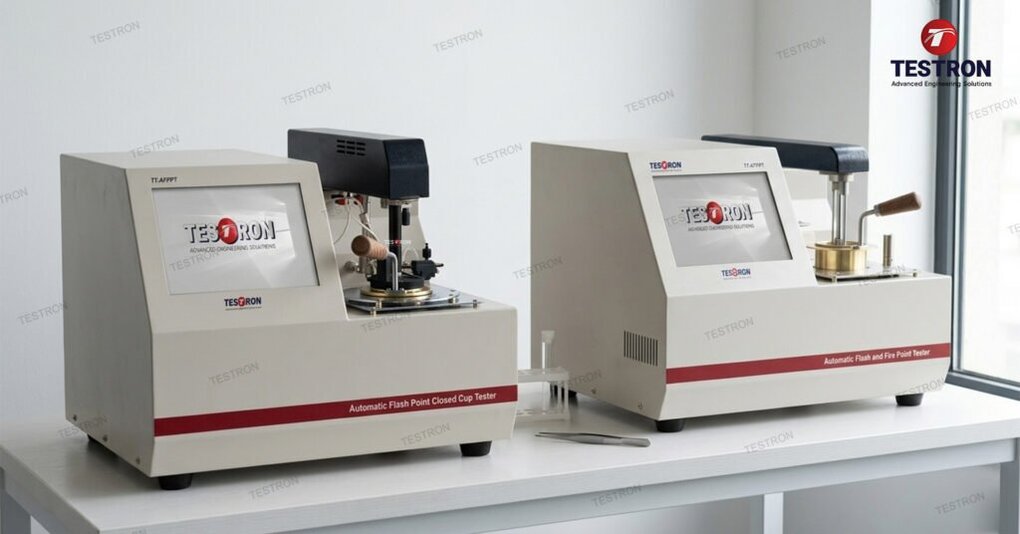
TT-AFPT Automatic Flash and Fire Point Tester (Cleveland Open Cup Flash Point Tester)
- This TT-AFPT Automatic Flash and Fire Point Tester is an embedded computer with an 8-inch color LCD touch screen, all English interfaces.
- Real-time display of expected flash point, applicable standard, maximum flash point, detection sensitivity, test status, and other information.
- It has the functions of automatic control of heating rate, automatic ignition, automatic judgment, automatic cooling, and so on.
- Can save 500 test results, and test data can be transmitted to the LiMS system.
- With electronic ignition and gas ignition two ways.
TT-AFPCT Automatic Flash Point Closed Cup Tester (Pensky-Martens)
- This TT-AFPCT Automatic Flash Point Closed Cup Tester, embedded computer, 8-inch color LCD touch screen, all English interfaces.
- Real-time display of expected flash point, applicable standard, maximum flash point, detection sensitivity, test status, and other information.
- It has the functions of automatic control of heating rate, automatic ignition, automatic judgment, automatic cooling, and so on.
- A stepper motor is used to stir the sample; the speed is stable and accurate, completely in line with AST D93 standard for stirring speed.
- Can save 500 test results, and test data can be transmitted to the LIMS system.
- With electronic ignition and gas ignition two ways.
Looking for the right equipment fit for your facility? Email us at info@testrongroup.com to receive the complete technical brochure for clarifying your doubts!
The 2026 Buying Guide: Which Tester Fits Your Strategy?
Investing in an Automatic Flash Point Tester setup in 2026 requires balancing upfront financial costs with long-term laboratory throughput, safety risks, and data reproducibility goals. Use this comprehensive framework to select the ideal system for your operational blueprint.
Identifying Your Primary Material Profile
- For Volatile Fuels and Bio-Blends
- For High-Temperature Lubricants and Residuals
- For Complex Chemical Formulations
Balancing Automation Against Budget Constraints
- Labor Efficiency
- Elimination of Human Bias
- Advanced Data Integration
Prioritizing Calibration and Local Maintenance
- Parts Availability
- ISO 17025 Conformity
- Parts Availability
Ready to optimize your procurement budget? Request a personalized, itemized quote on Flash Point Tester price!
Conclusion
Whether your operations demand the open-air simulation of a Cleveland open cup system for heavy lubricants or the sealed precision of a Pensky-Martens closed cup system for commercial bio-diesels, matching the petroleum testing equipment to your material profile is essential. Always view this procurement as an investment in a technical partnership.
Testron Group ensures that your laboratory gains access to durable hardware. Let’s build a safer, more efficient laboratory environment together.