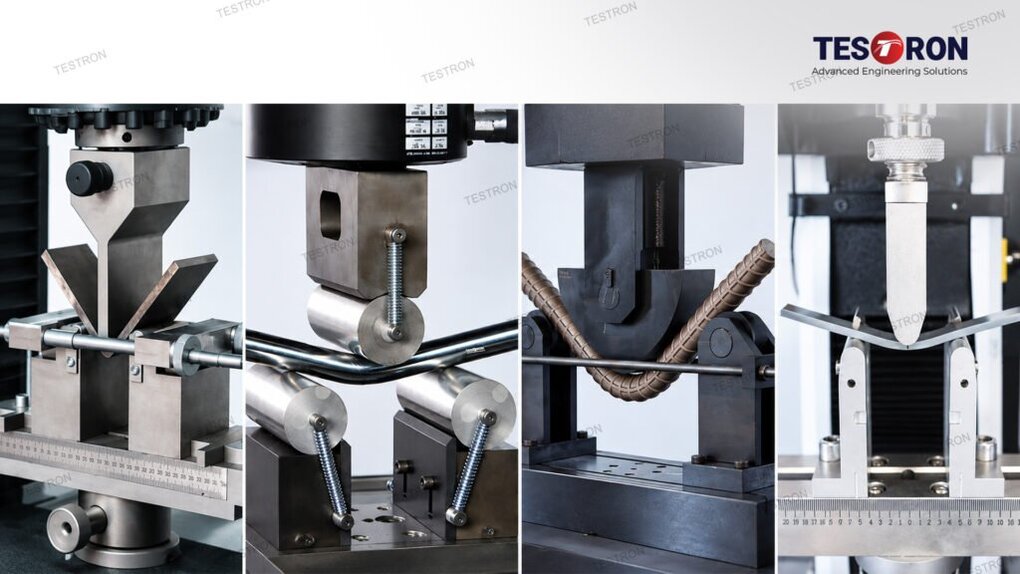
In this news, QC managers and lab operators will learn how the right Universal Testing Machine delivers the durability and consistency needed to outperform industry benchmarks.
Experience precision firsthand—schedule an interactive virtual demo to see our testing equipment live in action!
What Is Unlocking Bend Testing?
A universal testing machine (UTM) is very effective across several industries. Many engineering teams need the device to measure parameters such as flexural modulus, yield strength, and fracture resistance.
The UTM provides a controlled lab environment to analyze high-strength materials and advanced composites. Therefore, it is important to understand the flexural behaviour of the UTM.
The right tensile testing equipment assists QC managers in optimizing material strength. The right tensile test apparatus performs both tensile and flexural evaluations with maximum repeatable accuracy.
How Bend and Flexural Testing Works on a UTM
Flexural testing evaluates a specimen’s stiffness and resistance. This setup shows how the bending test and flexural test work while using the UTM.
The following format shows how it works in a real-world lab test:
1. Specimen Mounting and Alignment:
Place the test sample on the support anvils and center it under the loading nose.
2. Sensor Calibration and Taring:
Zero the load cell and displacement sensors in the software before starting the test.
3. Controlled Crosshead Loading:
Lower the crosshead at a constant speed to apply force onto the sample.
4. Real-Time Data Acquisition:
Record the force and sample bending continuously as the load increases.
5. Yield and Failure Point Capture:
Keep loading the sample until it deforms permanently, breaks, or hits the test limit.
6. Retraction and Automated Calculation:
Raise the crosshead and automatically calculate the flexural strength and modulus.
What It Measures & Industrial Applications?
The tensile testing machine measures the bend and flexural test results effectively. Let’s explore more of its applications and industrial applications:
Flexural Strength
Defines structural load-bearing limits under bending.
Flexural Modulus
Measures material stiffness and resistance to bending forces.
Yield Strength
Ensures components operate safely within elastic limits.
Ultimate Deformation
Assesses ductility and toughness under sustained bending forces.
Apart from the usage, the following industries demand the universal / tensile testing machine for various purposes, such as:
Automotive Manufacturing requires UTM for the following:
- structural brackets
- bumper beams
- composite body panels
Aerospace & Defense Elavtes Material Testing of the Following:
- Lightweight carbon fiber reinforced polymers (CFRP)
- High-temperature alloy sheets
Civil & Construction Engineering: Use UTMs for the Following:
- Concrete Beams
- Analyzes Steel Rebar
- Structural Lumber
Electronics & Packaging: Use the UTM for the following:
- Circuit board rigidity
- Protective cases
- Flexible packaging films
Global Compliance Of Tensile Testing Equipment
A calibrated universal testing machine utm ensures your lab satisfies all geometric fixture requirements. When it complies with necessary international standards, it protects manufacturers at all times in industrial use.
Some of the important established ASTM and ISO testing protocols are:
ASTM D790 & ISO 178
Check flexural properties of unreinforced and reinforced plastics and electrical insulating materials.
ASTM D6272
Useful for the assessment of flexural properties of electrical and plastic insulating materials.
ASTM D7264
Applicable for assessing flexural properties of fibre-reinforced polymer composites
ASTM C1609
Assess flexural performance of fiber-reinforced concrete using beam specimens.
ISO 14125
Very important for calculating the flexural strength of glass-fibre, carbon-fibre, and other reinforced composites.
ASTM E290
Make it verified for bend testing of metallic materials to evaluate ductility.
ISO 7438:2020
Certifies bend testing of metallic materials.
ISO 5173
Validates welding quality and joints by calculating the flexural strength.
Maintaining proper compliance protects manufacturers from product recalls and quality disputes.
Ensure 100% standard compliance across every production lot. Connect with the right universal testing machine manufacturer now to get more info about international regulations.
Testron Group UTM Lineup for Flexural & Tensile Testing
When users want the best testing solutions, they should invest in the right universal testing machine utm. Starting from the servo hydraulic universal testing machines to the electrical editions, Testron Group sells all types of UTMs around the globe. For your briefing, you can follow the given table:
Model Series | Force Capacity | Key Target Materials & Applications |
TT-SC Series | Up to 2 kN |
|
TT-DC Series | Up to 20 kN |
|
TT-EU Series | 30 kN to 300 kN |
|
TT-EH Series | 300 kN to 2000 kN |
|
TT-HT300 | High-Temp Specialized |
|
Ready to find the precise UTM model? Get a comprehensive universal testing machine price quote within 24 hours.
Conclusion
An advanced universal tensile testing machine can transform your lab as it helps to validate material structural integrity for various types of specimens. Therefore, investing in the right device to calculate fracture behaviour and flexural modulus is important for every QC manager and lab expert.
With Testron, we ensure our tensile test apparatus prevents material failures and strengthens overall operational efficiency. We are a universal testing machine supplier known for our state-of-the-art equipment and advanced after-sales solutions.
Related: Why Our Universal Tensile Tester Is the Top Choice for Malaysian Manufacturers
FAQs
Flexural Test: Provides a downward bending force to evaluate top-side compression and bottom-side tension.
Tensile Test: Exhibits a pulling force on a specimen from both ends to measure stretching force.