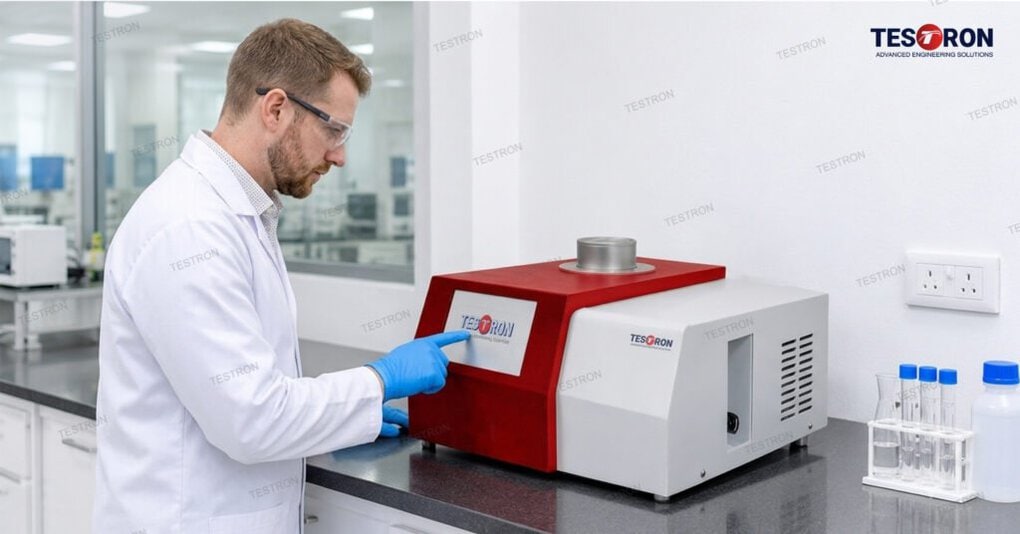
This blog explains OIT testing to streamline quality assurance. It helps operators to monitor material stability and enhance the antioxidant performance of specimens using the differential scanning calorimeter.
When users have the right DSC, they catch the cracks before they appear in service. Gain confidence in every test with Testron’s support.
Elevate Your OIT testing – Talk to Testron’s experts for future-proof production!
The Right Use of DSC – Testron’s Commitment
Polymer degradation testing is important for different manufacturers. They verify visible cracks and failures on material surfaces before mass production. The change in molecular state of any specimen happens during moulding and extrusion.
Users use the differential scanning calorimeter dsc to find out the Oxidation induction time (OIT). This value is useful for manufacturers to conclude the following:
- Identify Imbalances in Material Formulation Early
- Assess The Final Product
For a lab operator, it is important to collect actionable data while using Testron’s differential scanning calorimeter. It produces OIT that helps them to achieve robust material and strengthen the supply chain.
Talk to our product experts now and avoid unnecessary failures across every production batch!
Understanding the Core Purpose of OIT Testing
Oxidation induction time (OIT) measures the exact duration, expressed in minutes, that a polymer specimen resists oxidation under pure oxygen at a constant elevated temperature. By breaking down the core purpose of OIT testing, production teams transform raw thermal data into confident engineering decisions.
Note: A shorter OIT value signals depleted stabilizers, excessive processing heat, or contaminated feedstock.
With the OIT, manufacturers can identify the following:
- Monitoring Material Stability
- Evaluating Antioxidant Performance
- Comparing Raw vs. Processed Material
- Supporting Global Quality Hubs
- Driving Data-Backed Decisions
Lock in uncompromising polymer stability across your entire plant! Get a virtual demo with the right Differential scanning calorimeter supplier!
Testron’s DSC for Polymer Material Stability and Antioxidant Performance
Antioxidants serve as the primary shield. They protect polyolefins and specialty polymers from rapid oxidative breakdown. Talking about the formulators, they blend primary phenolic antioxidants and secondary phosphite stabilizers
This lets the final specimen survive high-temperature extrusion and decades of outdoor or underground service. The right differential scanning calorimetry equipment assesses these protective additives before the product even leaves the factory floor.
Consistent monitoring bridges the gap between laboratory formulation design and real-world manufacturing execution.
The Differential Scanning Calorimetry instrumentation is perfect for monitoring the following values:
- Primary and Secondary Stabilizer Synergy
- Process Optimization Insights
- Recycled Content Quality Control
- Long-Term Service Life Prediction
- Supplier Accountability
- Multi-Shift Consistency
Protect your brand reputation with verified antioxidant performance using Testron’s TT-DSC series differential scanning calorimeter!
Differential Scanning Calorimeter Working Principle and Global Standards
The Differential scanning calorimeter working principle relies on measuring the difference. It is based on the heat flow between a small polymer sample and an inert reference pan.
The entire process goes as follows: both undergo identical temperature and atmosphere programs. It is always advised to understand the working principle during the training sessions. Our experts can help you understand every bit of the TT-DSC series differential scanning calorimeters.
Now, it’s time to focus on Testron’s differential scanning calorimetry device standards:
ASTM D3895
- Standard test method for oxidative-induction time of polyolefins
ISO 11357 and ISO 11357-6
- Define general thermal analysis principles and specify isothermal OIT determination
ASTM D5885
- Governs high-pressure oxidative-induction time testing for polyolefin geosynthetics
Purchase from one of the best Differential scanning calorimeter manufacturers & align your testing laboratory with internationally recognized OIT standards!
Testron Group Differential Scanning Calorimeter Models
We have two unique differential scanning calorimetry instruments:
Let’s understand the key parameters of Testron’s TT-DSC series, making it ideal for OIT testing for polymer manufacturers:
Parameter | DSC Differential Scanning Calorimeter (Compact Unit) | TT-DSC300 Differential Scanning Calorimeter |
Temperature Range | Room temp to 500 °C | Room temp to 600 °C |
| Temperature Resolution | 0.1 °C | 0.001 °C |
Heating Rate | 0.1–80 °C/min | 0.1–100 °C/min |
| DSC Range | 0 to ±200 mW | 0 to ±1000 mW |
DSC Sensitivity | 0.1 mW | 0.001 mW |
| Atmosphere Control | O₂ / N₂ manual or timed switch | Automatic switching with dual flow |
Sensitivity & Stability | Good baseline stability | Shielded circuits, high baseline stability |
| Key Applications | OIT, melting, glass transition | Full DSC, curing, oxidation, kinetics |
Compare Testron DSC pipe testing machines today and request a customized quote tailored to your laboratory budget!
Conclusion
Oxidation induction time (OIT) is an important value for polymer manufacturers. It stands out as an indispensable window into material stability and antioxidant effectiveness.
Testron Group’s Compact DSC or ultra-sensitive TT-DSC600 empowers laboratories with the best device to avoid costly failures occurring in the field. Each standard ensures every measurement stands up to strict global customer scrutiny.
These OIT results using the DSC form the backbone of world-class polymer quality assurance across every industrial hub.
Partner with Testron Group at info@testrongroup.com for reliable thermal analysis solutions!
FAQs
– ASTM D3895
– ISO 11357-6
– ASTM D5885
– EN 728
– Model Selection
– Gas Modules
– Automation Features
To get a customized quote, talk to our experts through our official handle.