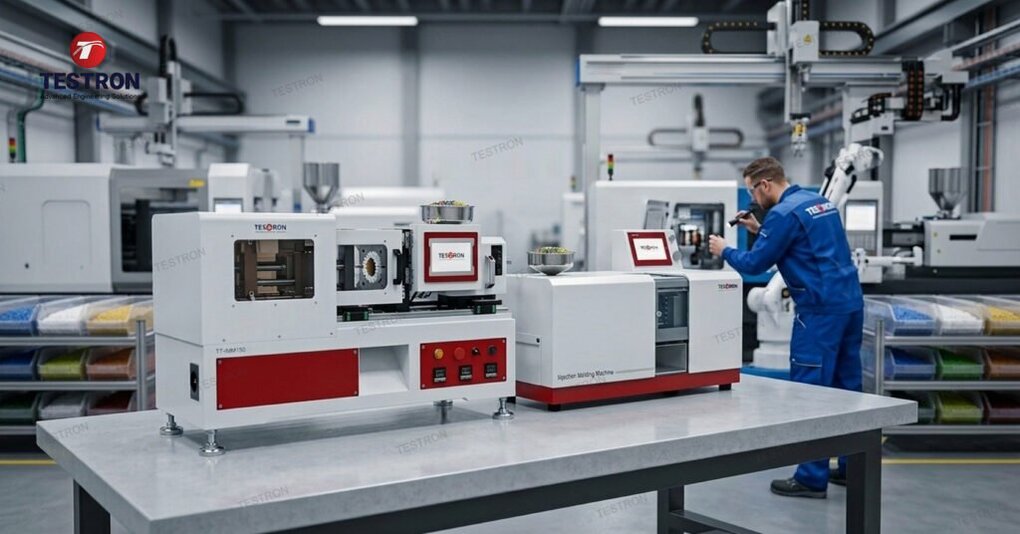
This blog analyzes benchtop versus full-scale molding machinery, empowering American facilities to optimize production footprint and lower capital expenditures.
Upgrade your laboratory’s material testing speed—speak directly with an application engineer now!
Deciding Between Precision Scale and Production Power for American Manufacturing
Modern labs in 2026 demand high-precision material testing equipment from trusted manufacturers and suppliers with long-term support. That’s why many industrial labs and academic institutions choose Testron’s advanced solutions to upgrade their existing systems and setups in the USA.
However, choosing between a compact benchtop injection molding machine and a traditional industrial injection molding machine is one of the most critical facility decisions. Many factors are to be considered first, such as:
- Performance
- Compliance
- Cost Structures
- Technical Capability
All these attributes can give investors the right idea where to invest with complete confidence. However, the manual benchtop injection molding machine isn’t outdated, but need human efforts, skills, and experience to operate it perfectly and get the benefits out of it.
Upgrade your laboratory’s material testing speed through the benchtop injection molding machines—speak directly with an application engineer now!
Understanding the Core Differences: Benchtop vs. Full-Scale Machinery
Time to learn about the right benchtop injection molding machine compared to full-scale hydraulic or electric production presses.
Benchtop Plastic Injection Molding Machine | Full-Scale Plastic Injection Molding Machine |
Operates on standard lab tables with low power draw | Requires thousands of square feet, reinforced concrete foundations, and high-voltage three-phase power. |
Provides a flexible, space-efficient alternative tailored for modern laboratories | Utilizes giant hydraulic, hybrid, or electric drive mechanisms thar requires maximum space |
Delivers rapid turnaround for low-volume production, testing, and custom component prototyping. | Excels at continuous million-part runs. |
Tooling Cost starts at a fraction of full-scale mold costs | Toolking is higher compared to the benchtop model. |
| Fits neatly into existing facility layouts. | Presents substantial barriers to entry for short-run projects. |
When evaluating a benchtop injection molding machine in the USA, the systems can deliver the following benefits in favor of your testing protocols:
- Operational scale
- Footprint and Portability
- Material Efficiency
- Power Requirements
- Tooling Complexity
Remember, a benchtop industrial injection molding machine, Testron’s TT-IMM series, delivers superior operational agility without the massive overhead.
Ready to find the perfect molding fit for your facility? Comment “BENCHTOP” below to instantly receive the technical breakdown guide from a verified injection molding machine benchtop manufacturer in the USA.
Financial Analysis: The Perfect ROI Comparison for Labs
The right investment can balance the capital expenditure and ongoing operational costs. With Testron’s TT-IMM series, users can get their chance to solve the issues. . In contrast, an Injection molding machine benchtop price delivers a turnkey solution at a small fraction of that cost.
That’s how the labs can reserve capital for product design, material procurement, and market expansion.
| Evaluation Metric | Benchtop Injection Molding Machine | Full-Scale Industrial Press |
| Initial Investment | Lower Capital Requirement (benchtop injection molding machine price) | High Capital Investment |
| Tooling Cost | Low per mold | High per mold |
| Energy Consumption | Low (2.5 kW – 3.5 kW) | Very High (20 kW – 100+ kW) |
| Footprint Required | Compact Tabletop | Large Factory Floor Space + Auxiliary Chiller/Dryer |
| Operator Expertise | User-friendly Touchscreen Interface | Dedicated Certified Injection Molding Technicians |
| Primary Use Case | R&D, ASTM Specimen Prep, Micro-Parts, Prototyping | High-Volume Mass Manufacturing |
With Testron’s Plastic injection molding machine benchtop, users can get the following benefits:
- Tooling Capital Savings
- Drastic Utility Reductions
- Material Waste Minimization
- Labor and Operating Costs
- Accelerated ROI
Remember, the reduced benchtop injection molding machine cost delivers superior financial returns. It boosts the production rate, material validation, and product design for the US-based labs.
Want a custom financial comparison for the plastic testing equipment? Type “ROI” in the comments to receive our interactive benchtop injection molding machine price list.
Product Spotlight: TESTRON Group Benchtop Solutions
Testron’s legacy starts with its advanced material testing equipment, such as: TT-IMM, TT-IMM150, and TT-IMM150A. The debate between choosing between manual and servo-automated precision systems won’t be that hard after you get into the practical advantages and robust engineering design of the TT-IMM series injection molding machine benchtop in the USA.
Let’s understand the key pointers first:
- Designed specifically for high-precision laboratory testing
- Bridge the gap between simple manual sample cutters and large industrial machines
- Offer commercial-grade accuracy in a compact footprint.
- Incorporates high-grade components & is easy to maintain.
- Provides structural durability across demanding applications.
- Comes with a rigid, vibration-free platform for precise mold registration.
Selecting a high-performance benchtop injection molding machine for sale from TESTRON gives facilities complete access to enterprise-grade molding technology, robust build quality, and comprehensive technical support.
Demanding a robust design from the nearest injection molding machine benchtop supplier in the US market? Message our technical support specialists for an expert facility checklist!
Conclusion
Choosing between a benchtop and a full-scale injection molding machine isn’t just about size or any type of feature. This leads to operational strategy and efficiency. For the US market, a high-precision benchtop injection molding machine delivers an unbeatable balance of performance and value.
With Testron, users get rapid R&D, ASTM/ISO material testing compliance, short-run production, and low capital risk. Now is the time to elevate your quality control capabilities with industry-leading desktop molding solutions.
Related: Best Benchtop Injection Molding Machine in the USA: Compare Features, Price & Performance