
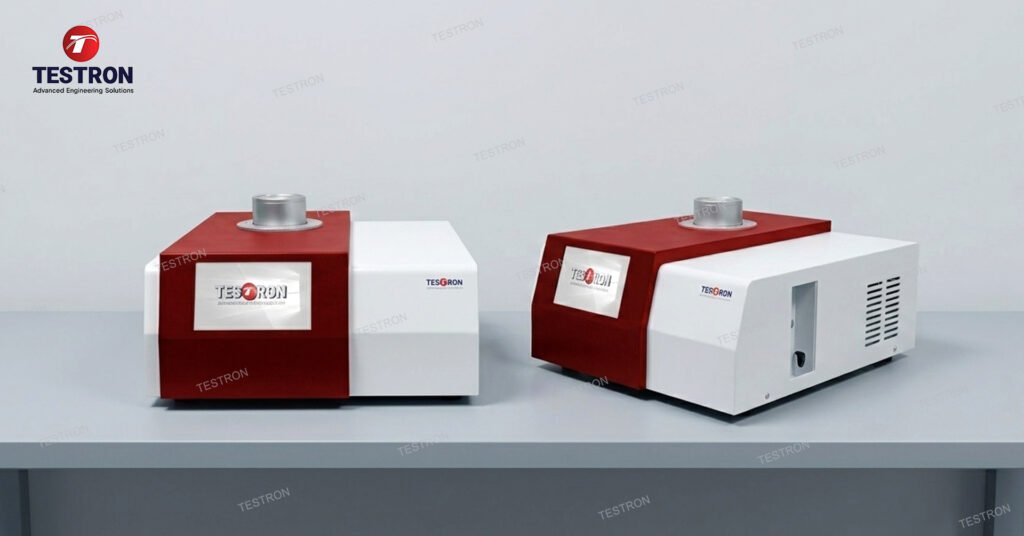
Introduction: The Impact of Precision in Differential Scanning Calorimetry
The demand for quality control and assurances of performance is always on the rise in the European continent and worldwide. Spain can’t just keep itself away from the trend of having the best range of thermal analytical instruments for advanced pipe testing.
As many labs and industries seek higher precision in the polymer and pharmaceutical sectors, the introduction of the finest pipe testing equipment is a must-go option.
Among all the major QC tools, the use of differential scanning calorimetry in Spain is also higher across labs and industries, as it is useful for efficient and accurate thermal analysis of different samples.
Worried about the best Differential Scanning Calorimetry supplier – reach out to Testron and explore all the options now!
The Core Foundations: Understanding the Differential Scanning Calorimetry Principle
The differential scanning calorimetry principle is the bedrock of modern thermal analysis, providing a window into the molecular behavior of materials as they respond to thermal energy.
The fundamental principle of this material testing laboratory equipment is simple. It analyses the difference in the amount of heat required to increase the temperature of a sample and a reference as a function of temperature.
Let’s understand the principles of differential scanning calorimetry in Spain is simple ways:
- Melting Point (Tm): The temperature at which a crystalline solid turns into a liquid.
- Crystallization Temperature (Tc): The point where molecules align into a structured lattice during cooling.
- Heat Capacity (Cp): The amount of heat required to change a substance’s temperature by one degree.
- Glass Transition Temperature (Tg): The point where a hard, glassy material becomes soft and rubbery.
- Thermal Stability: How long a material can withstand high heat before degrading.
By mastering the working principles of a dsc differential scanning calorimetry, manufacturers can predict how a product will behave in the sweltering heat of a Spanish summer or the mechanical stress of an industrial engine.
Curious about how thermal analysis & performance of Testron’s differential scanning calorimetry equipment? Contact our technical team today!
Exploring the Versatile Differential Scanning Calorimetry Applications
The versatility of differential scanning calorimetry applications makes it one of the most widely used analytical tools in Spain’s industrial sector. One of the most critical sectors utilizing this technology is the infrastructure industry, specifically regarding pipe testing tools.
Beyond pipes, the applications of the differential scanning calorimetry instrumentation include:
- Distinguishing between different grades of polyethylene by analyzing their unique melting peaks.
- Analyzing the melting profiles of fats and chocolates to ensure the perfect “food” and shelf-life stability in various climates.
- In the aerospace and automotive sectors, DSC monitors the curing process of epoxy resins and composites to ensure they have reached maximum strength.
- In Pharmaceuticals, many drugs can exist in different crystalline forms (polymorphs); DSC identifies the most stable form to ensure the drug dissolves correctly in the body.
- A differential scanning calorimetry machine helps in quality control as it detects contaminants in recycled plastic batches, ensuring they are pure enough for reuse.
Unlock the hidden potential of your raw materials – explore more from one of the best Differential Scanning Calorimetry manufacturers, Testron!
Choosing Your Machine: Testron’s Differential Scanning Calorimetry Instrumentation
When it comes to selecting a differential scanning calorimetry in Spain, Testron Group has developed a range of models that cater to everything from basic educational labs to high-stakes research centers.
Key technical features to look for in Testron’s differential scanning calorimetry in Spain include:
- Integrated furnace, the user-selectable rate for temperature rising or falling.
- An industrial computer is introduced with rich information, e.g., set temperature, sample temperature, Oxygen flow rate, Nitrogen flow rate, DSC signal, the status of switches, and flow rate zeroing.
- Double temperature sensors ensure the high repeatability of test results. One sensor is installed on the wall of the furnace, and the other is at the bottom of the sample for collecting the real test temperature.
- Patented controlling technology is applied to make the temperature of the sample reach the setpoint by controlling the temperature on the wall of the furnace.
- Standard sample provided for calibrating the constant temperature coefficient.
- Digital mass-flow meter switches the flow rate of Oxygen/Nitrogen automatically with a fast switching speed.
- Simplified to a one-key operation. Tens of commands can be combined on your demand, making the operation easier. Also, support the self-programming function.
Don’t settle for average—upgrade to Testron’s world-class DSC at a genuine Differential Scanning Calorimetry price!
Conclusion
The advancement of differential scanning calorimetry in Spain represents a significant leap forward for the nation’s manufacturing sector. Whether you are looking for a high-performance DSC machine for R&D or a durable unit for the production floor, understanding the nuances of thermal analysis is the key to industrial longevity.
Time to invest in Testron’s top-rated differential scanning calorimetry in Spain. In case of any doubt regarding this material testing equipment, email us info@testrongroup.com now!
