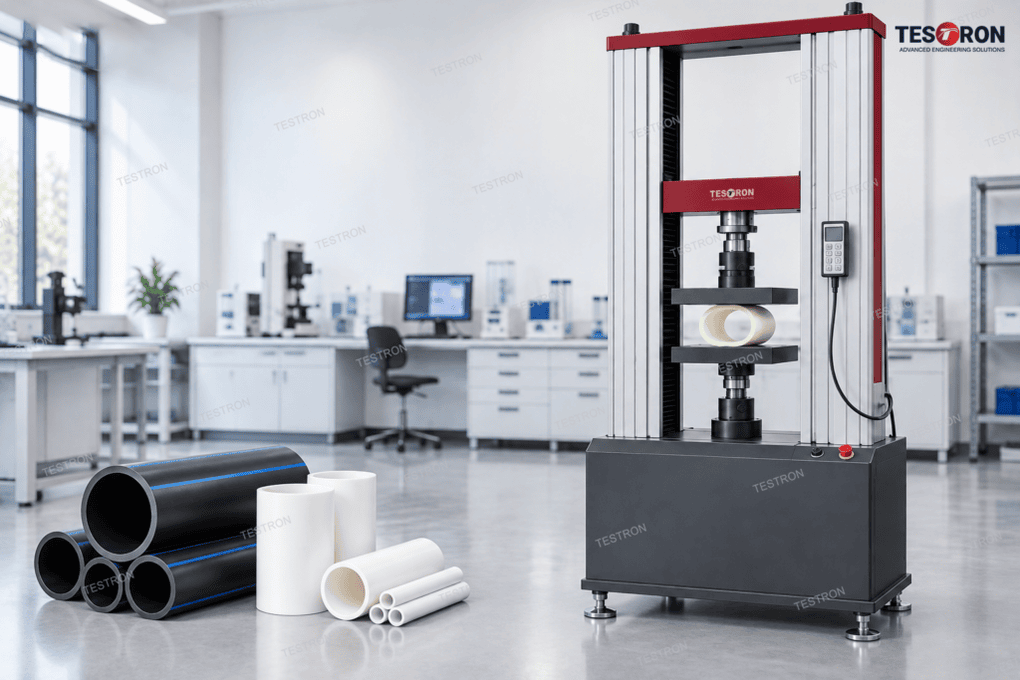
To ensure quality, plastic pipes should be tested for mechanical performance. This includes mechanical strength, tensile strength, and performance when exposed to challenging environments. Plastic pipes are used in many applications, including water delivery, drainage, gas delivery, and industrial pipework.
The tensile properties of plastic pipes can be measured with the use of a universal testing machine (UTM). Tensile strength, yield strength, and breaking elongation can be measured. This means that plastic pipe manufacturers can understand how the material would react to forces and can understand any weaknesses within the manufacturing process.
With increasing demand for high-quality HDPE, PVC, PPR, and PP pipes, high-specification tensile testing equipment has become very important to ensure good product quality.
Find out how Testron can help you with testing plastic pipes with a universal testing machine. Speak to the technical team to see what test solutions may be suitable for your laboratory.
Why is tensile testing important for plastic pipe manufacturing?
Plastic pipes will be subjected to various mechanical forces throughout handling, installation, and service. If plastic pipes do not have sufficient tensile strength or insufficient elongation of material, then this could affect structural integrity.
A universal tensile testing machine can be used to understand how plastic pipe materials will perform under mechanical force. The sample is loaded with a controlled tensile force.
Using a tensile test for plastic pipes allows the following information to be determined:
- Tensile Strength: Maximum stress that can be applied before failure.
- Yield Strength: Stress where permanent deformation occurs.
- Breaking Elongation: Amount of elongation before failure.
- Elastic Properties: Understanding how the material behaves under certain forces within the elastic region.
- Consistency of Material: Helps determine material consistency between batches.
This allows quality checks of raw materials, monitoring of manufacturing processes, product development, and quality assurance.
Applications in Plastic Pipe Testing
Universal material testing machines can be used in a variety of plastic pipe testing applications.
- Tensile Test of HDPE Pipe
High-density polyethylene (HDPE) pipes are used in water delivery, gas delivery, and industrial liquid transport. Yield strength and elongation can be tested to understand material consistency.
- PVC Pipe Mechanical Testing
PVC/CPVC pipes are common in plumbing, drainage, and industry. Testing can be carried out to determine tensile strength, breaking stress, and elongation.
- PPR Pipe Material Testing
Polypropylene random copolymer (PPR) pipes are used in the delivery of hot and cold water. Tensile tests can be performed to understand the properties of this material and allow manufacturers to monitor mechanical properties.
- Pipe Joint & Fusion Weld Testing
Tensile testing can also be performed on samples made up of butt fusion joints in polyethylene pipework. This allows manufacturers to understand how joints have failed and to determine the quality of the weld. The appropriate test method should be carried out.
- Research & Material Development
Tensile testing equipment can be used by plastic manufacturing companies or research laboratories. They can be used to compare different grades of polymer, material development, and testing of recycled plastics.
Looking to improve mechanical testing capabilities in your plastic pipe manufacturing process? Find out more about universal testing machines from Testron.
Principle of Operation of Universal Testing Machine
A Universal Testing Machine (UTM) applies a controlled tensile force to samples.
Samples are placed between the top and bottom grips. The machine can then be set to move at a given speed, so the sample is stretched until failure or yielding occurs.
Throughout the test, information is collected by the load cell (the force being applied) and an extensometer or suitable device to measure extension.
Important Technical Information:
Technical Parameter | Testing Purpose |
Load Capacity | Determines the maximum force the machine can apply. |
| Load Cell | Measures the tensile force applied to the specimen. |
Test Speed | Controls the rate of specimen extension. |
| Extensometer | Measures specimen elongation accurately. |
Grip Arrangement | Holds the specimen securely during testing. |
| Displacement Measurement | Records crosshead movement during testing. |
Data Acquisition | Records force, extension and stress-strain data. |
| Software Analysis | Generates test reports and stress-strain curves. |
Depending on requirements, either electromechanical or servo-hydraulic UTMs can be used. Electromechanical testing is often suitable in plastic testing applications, whilst servo-hydraulic testing is generally used for higher forces.
ASTM & ISO Standards Related to Plastic Pipe Tensile Tests
It is important to know what standard is required for tensile testing in order to choose the correct tensile test equipment. Below are some standards associated with tensile testing for different plastics.
Standard | Description |
ASTM D638 | Tensile properties of plastics using standard test specimens. |
ISO 527-1 | General principles for determining tensile properties of plastics. |
| ISO 527-2 | Tensile testing conditions for molded plastics and extruded plastics. |
ISO 6259-1 | General method of determining tensile properties of thermoplastic pipes. |
| ISO 6259-2 | Tensile properties of PVC-U, PVC-O, PVC-C, and PVC-HI Pipes |
ISO 6259-3 | Tensile properties of polyolefin pipes. Includes PE, PE-X, PP, and PB. |
| ISO 13953 | Tensile strength and failure mode of samples of fused joints in PE pipework. |
General specimens can be tested using ASTM D638 or ISO 527. However, to test thermoplastic piping, ISO 6259 standards should be followed. The appropriate standard, specimen design, testing rate, and conditioning must be considered according to the material being tested and the desired test.
Importance of Calibration on Universal Testing Machines
To obtain accurate results from mechanical tests, universal testing machines must be routinely calibrated. This gives reliable data.
Testing equipment should be calibrated so that
- Accuracy in force measurement
- Check load cells and grips.
- Accuracy in measurement of extension
- Accuracy in test speed
- Routine maintenance of mechanical/electrical parts.
To confirm force measurement, consult ASTM E4. The equipment must be calibrated according to the right standard and laboratory standards.
Selection of Universal Testing Machine Supplier
Consider the following factors when selecting a universal testing machine:
- What load capacity is required based on the specimen size and expected loads
- Compliance with relevant ASTM and ISO standards
- Grips suitable for plastic pipe specimens
- Extensometer requirements
- Software requirements for stress/strain analysis
- Calibration support and technical support.
The price of the universal testing machine will vary depending on the load capacity, accessories, software, level of automation, and application requirements. Consider the overall test system configuration and not just the price of equipment.
Would you like to invest in reliable tensile testing equipment for plastic pipe testing? Get in touch with Testron to find the right UTM setup, test accessories, and solutions for your testing requirements.
Conclusion: Improvement of Plastic Pipe Quality with Correct Tensile Tests
Knowing the properties of plastic pipes is very important to ensure high quality. Using a universal/tensile testing machine, plastic pipe manufacturers can know more about the material properties, tensile properties and quality of the plastic pipe.
Tensile tests can be carried out on HDPE, PVC, PPR and Polyethylene fuse joints. This means useful data can be obtained to know how best to manufacture this material.
At Testron, we are trusted to manufacture testing equipment. Choosing the correct material testing equipment for your laboratory equipment can improve quality control within your production.
To improve plastic pipe testing, use Testron’s Universal Testing Machine. Please get in touch with us today to discuss your requirements. We can find the right solution to suit your testing requirements