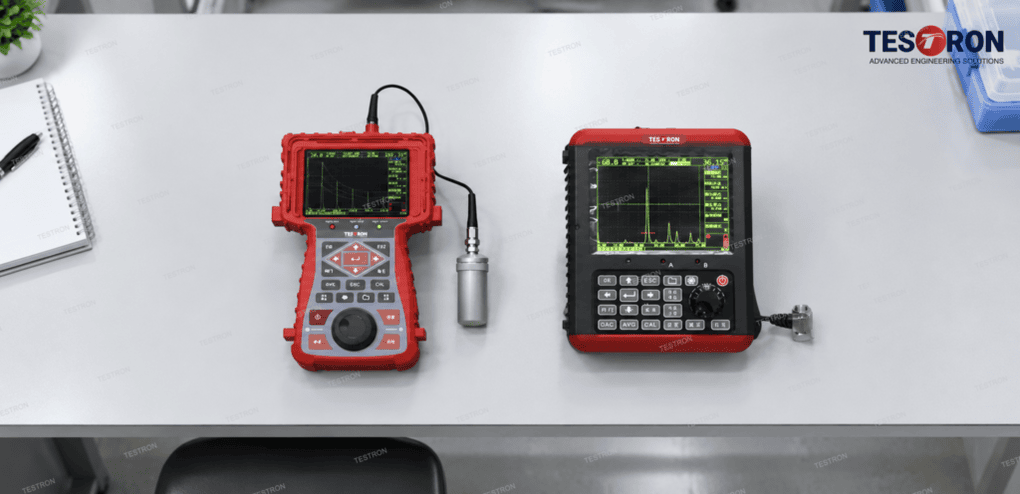
The blog explains the secrets of improving performance and accuracy in QC protocols. It shows how to pick the right reliable ultrasonic flaw detector in the UK. This helps quality managers to ensure total structural safety and compliance. Also, QC managers and lab experts can understand how to streamline non-destructive testing workflows with confidence across major British industrial hubs in 2026.
Ensure 100% compliance on every weld check —claim your personalized Testron Group quote instantly!
Introduction: The Evolution in Advanced Non-Destructive Testing
In 2026, modern labs in the UK are no longer lingering with old or outdated models. They want advanced and dedicated equipment to drive precision without causing any internal or external damage to specimens. With advanced-grade material testing devices, physical assessment becomes easier for QC managers and lab experts.
Having an advanced ultrasonic flaw detector in the UK removes the hurdles for engineers and lab managers. Having ultrasonic NDT gadgets simplifies non-destructive testing under different circumstances.
Having a significant portable ultrasonic flaw detector in a lab, an operator elevates safety benchmarks and drives operational excellence.
Explore Testron Group’s ultrasonic flaw detectors with local experts across London, Birmingham, and Manchester – request your custom guidelines now!
Understanding the Core: How an Ultrasonic Flaw Detector Works
The performance of a device depends on its capabilities and efficiency. With Testron, users can have the best device along with comprehensive knowledge of the ultrasonic flaw detector working principle.
A modern digital ultrasonic flaw detector is perfect for both old and advanced labs for the best upgrade. With Testron’s guidance, users can achieve the following in critical infrastructure components before they enter service.
- Eliminate Subjective Guesswork
- Optimize Transducer Selection
- Diagnose Structural Defects
Let’s follow the actual steps involved in the working of an ultrasonic flaw detector machine:
Step 1: High-Frequency Wave Generation
- Generate high-frequency electrical pulses
Step 2: Acoustic Signal Transmission
- Converts the electrical pulses into mechanical sound waves
Step 3: Uniform Sound Wave Propagation
- Waves travel at a constant velocity through the test piece.
Step 4: Boundary & Defect Wave Reflection
- An acoustic impedance mismatch causes sound waves to reflect
- Some part of the wave energy bounces back.
Step 5: Converting the Echo Signal
- Converts the sound vibrations into high-precision electrical signals.
Step 6: Digital Signal Processing
- Sensors process the electrical signals and display them as an intuitive A-scan waveform
- The system plots signal amplitude against time-of-flight
Contact our technical specialists to learn more about ultrasonic flaw detector diagrams, advanced acoustic analysis, and equipment integration!
Navigating Essential Equipment: Digital & Portable Solutions from Testron
Proper testing hardware is a strategic decision. It depends on specifications, throughput, and testing environments.
A high-performance portable ultrasonic flaw detector is currently in heavy demand. It is Testron’s TT-D500. We design this device with shock-resistant housings, long-lasting battery configurations, and high-visibility displays
Also, the TT-D1150 ultrasonic flaw detector apparatus is another masterpiece from Testron. It ensures continuous inline quality verification. These digital instruments empower quality directors in different ways across all produced batches, such as:
- Establish traceable &automated inspection logs
- Simplify auditing
- Uphold zero-defect quality mandates
- Maintain absolute structural reliability
Both of the ultrasonic flaw detector instruments have the best features that QC managers and lab experts always want to fulfill their material assessment requirements, such as:
- Offer lightweight ergonomics and long battery life for remote testing
- Conduct rapid, repeatable quality checks
- Deliver exceptional signal clarity and high-capacity data storage
- Designed for challenging industrial environments
- Broader material testing hardware
Browse our complete range of the best ultrasonic flaw detectors and secure your equipment today!
Investment Value: Analyzing Ultrasonic Flaw Detector Price and ROI
This material testing lab equipment from Testron has the best ROI in UK-based labs. It is useful for the following lab assessments:
- Forging & Casting Analysis
- Weld Inspection Excellence
- Asset Life Extension
- Aerospace & Defense Readiness
- Standardization Compliance
The Ultrasonic flaw detector uses the best systems to boost industrial applications. It reduces material waste and speeds up final quality clearance times.
Remember, utilizing certified ultrasonic flaw detector equipment protects key assets and prevents expensive operational downtime. Not only that, you can boost reliability and long-term business growth with it.
Talking about ROI, it gives you the following in return:
- Risk Mitigation
- Reduced Scrap Rates
- Operational Efficiency
- Competitive Advantage
- Durability & Longevity
Contact Testron Group today to discover competitive pricing and flexible acquisition options for your facility!
Conclusion
The industrial standards in the UK are elevating with the introduction of modern and advanced metal testing machines. When it comes to the best ultrasonic flaw detector in the UK, Testron TT-D500 and TT-D1150 are two frontrunners.
We remain committed to empowering quality control managers, laboratory technicians, and industrial leaders across the UK. Talk to us at info@testrongroup.com about efficiency and advanced material testing while using our premium devices. Time to elevate your manufacturing quality to new heights!
FAQs
– Detection sensitivity and accuracy
– Material type and thickness
– Probe compatibility
– Display and data recording capabilities
– Portability and battery life
– Applicable industry standards and calibration requirements
Choosing the right configuration helps ensure reliable results for your specific inspection application.