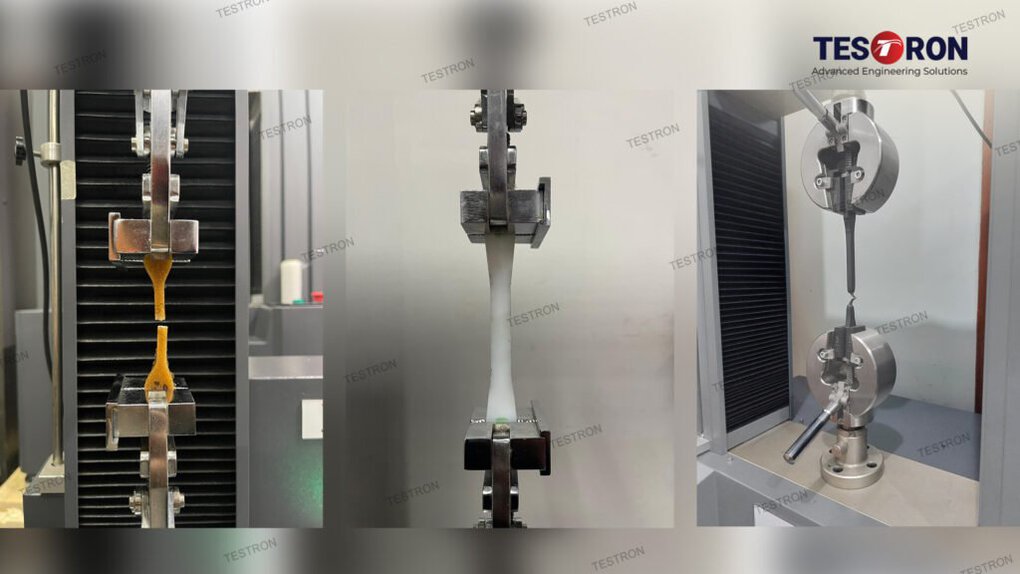
This blog explores the importance of ASTM D638 in a tensile testing machine, meant for plastic specimens. It shows how a UTM plays an important role in extracting meaningful material performance data.
See what your plastic material can really withstand. Start with the right testing approach from Testron’s UTM.
Introduction
Plastic manufacturing is not an uncommon factor in the industrial revolution. It is significant across several countries, and it is a global-tier manufacturing sector that many industrialists are focusing on the most.
To get valid and compliant products, it is necessary to comply with valid manufacturing protocols. The ASTM D638 is a valid tensile testing standard. It provides a recognized method for determining tensile properties of plastics.
Testing Range of A Universal Testing Machine for Plastics
A universal tensile testing machine is a useful tool that applies controlled force to a plastic sample and records responses by conducting the following tests:
- Tensile strength
- Elongation
- Yield behaviour
- Elastic modulus
- Deformation
- Breaking behaviour
- Force-displacement behaviour
- Stress-strain behaviour
Two plastics can have similar tensile strength but very different elongation. The tensile testing equipment from Testron Group has helped manufacturers to assess plastic and rubber materials. Our UTMs support ASTM D638 and ISO 527 among the list of supported testing standards.
It’s time for you to measure more than the breaking force. Build a complete plastic material testing workflow.
The Simple Definition of ASTM D638 in UTM
A tensile testing machine is validated with ASTM D638. That’s how it shows quality for the following test results of plastic materials:
- Tensile property data for control
- Specification
- Characterization
- R&D sectors
In the case of ASTM D638, the standard controls specimen preparation and test conditions. It provides meaningful comparative results.
How Does ASTM D638 Tensile Testing Work?
The complete procedure that ASTM D638 specifies for the tensile test apparatus is mentioned below:
- Step 1: Prepare the plastic specimen
- Step 2: Condition the specimen
- Step 3: Measure the specimen
- Step 4: Mount the specimen
- Step 5: Set the test method
- Step 6: Apply tensile force
- Step 7: Record force and deformation
- Step 8: Analyse the curve
- Step 9: Record the result
ASTM verifies three major parameters of specimen testing, starting with preparation, speed, and environment. Without the proper regulations, the tensile test equipment won’t provide an accurate result.
Upgrade your plastic material evaluation with a reliable universal testing machine manufacturer anywhere in the world!
Choosing the Right Tensile Testing Machine for Plastics
Before you pick the right universal / tensile testing machine from Testron, it is important to verify the following factors for getting the accurate results while testing several plastic specimens.
We recommend that users consider the following selection factors:
- Required measurement range
- Maximum expected test force
- Crosshead speed
- Accuracy
- Extensometer requirement
- Displacement measurement
- Specimen dimensions
- Grip type
- Software
- Data reporting
- Test space
- Future testing requirements
- Calibration
- Laboratory workload
Match everything before you buy – connect with the right universal testing machine utm supplier right now!
Single Column vs Double Column Universal Testing Machines
At Testron, users find unique universal material testing machines. That’s why they need to verify what they need to conclude the testing.
Let’s understand the differences between single column and double column UTMs:
Single-column systems
Best for the following uses:
- Compact laboratories
- Lower-force applications
- Research
- Education
- Small specimens
- Routine material testing
At Testron, these single-column models range from 50 N through 5 kN, plus a 1,000 N and 2,000 N model in the same category.
Double-column systems
Best for the following uses:
- Larger testing spaces
- Greater structural capacity
- Higher-force laboratory work
- Broader material applications
At Testron, the range of UTMs starts at 2 kN, 5 kN, 10 kN, and 20 kN.
The TESTRON UTM Range for Industrial Laboratories
Explore the complete range at Testron before making a selection. Here is the list:
Bench-top single-column:
Bench-top double-column:
Electro-hydraulic servo:
Servo hydraulic universal testing machines:
Specialised testing
- TT-HT300 — High Temperature Tensile Testing Machine
- TT-SP2000 — 2 kN Multi-Channel Solar Cell Testing Machine
Review the full universal tensile testing machine range and identify the capacity and configuration that fit your application.
How to Think About Universal Testing Machine Price
It is not recommended to choose the lowest UTM price. A bad or cheap investment won’t provide accurate and repeatable testing. Instead of investing in poor devices, it is wise to go with Testron’s premium UTMs with premium features.
The entire pricing, benefits, and ROI are dependent on the following factors:
- Machine architecture
- Maximum force
- Servo system/Hydraulic system
- Load cell & Accuracy
- Extensometer
- Grips & Software
- Test chamber & Automation
- Installation to universal testing machine calibration
- Training, Service, and Warranty
All of the above can be yours when you choose Testron’s compliant devices.
Build a long-term testing partnership, not a one-time equipment purchase. Invest in Testron now!
Conclusion: Build A Better Plastic Testing Protocol in Your Lab
Reliable testing begins with a dependable UTM. Without the right setup, it leads to failed results. ASTM D638 is responsible for building a robust framework. This standard evaluates the tensile properties of plastics. TESTRON’s current universal testing machine price range covers multiple capacities and machine configurations.
Email us at info@testrongroup.com and discover more about testing standards and Material Test Equipment.