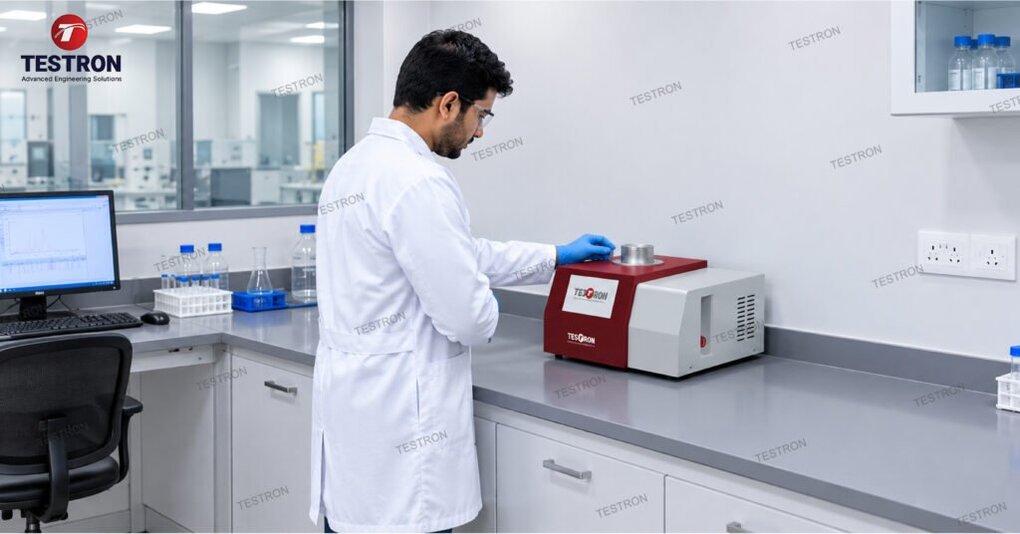
This blog is all about demonstrating the differential scanning calorimetry principle in the USA. It also shows what it can do apart from precise heat flow measurement. Time to equip your facility with world-class thermal instruments.
Claim your free DSC application consultation with our engineering team immediately!
Decoding Thermal Analysis for Modern US Manufacturing
Advanced material testing is no longer optional for high-tech industries. Understanding the differential scanning calorimetry principle in the USA gives engineering teams a distinct edge in operational reliability.
With the right device, lab directors and plant managers can accurately forecast material longevity, processing behavior, and structural integrity. Now, users with Testron’s differential scanning calorimetry dsc principle can meet strict industrial requirements without costly downtime or material failures.
Review application-specific testing profiles.
Defining Differential Scanning Calorimetry: Core Fundamentals
The differential scanning calorimetry dsc principle is centered on measuring the energy uptake or release as a sample undergoes controlled thermal changes.
Remember that the principle of differential scanning calorimetry is set apart into two primary review setups:
- Heat-flux: Both sample and reference sit inside a single furnace, and heat flows into both through a shared conduction path
- Power-compensated systems: Separate micro-furnaces maintain identical temperatures by dynamically adjusting power inputs.
Quality assurance teams often review a differential scanning calorimetry principle pdf to get a thorough idea. Now, they can prepare the presentation to train lab staff on these thermodynamics.
The quick analysis of endothermic (heat-absorbing) and exothermic (heat-releasing) processes helps the labs to obtain an unambiguous thermal fingerprint of their test materials.
Want comprehensive DSC technical specs and analytical support based on the obtained differential scanning calorimetry principle slideshare?
Speak directly to our thermal analysis engineer today!
Differential Scanning Calorimetry Instrumentation and Working Principle
Understanding the differential scanning calorimetry working principle is important. Each differential scanning calorimetry principle and instrumentation carries a deeper meaning, and it represents a highly coordinated system designed for extreme measurement accuracy.
Let’s see how Testron’s DSC device works and holds its secrets:
- Heating Furnace: Heats sample and reference pans evenly.
- Temperature Sensors: Sensitive detectors that track small temperature changes.
- Gas Controller: Controls flow rates for nitrogen and oxygen gases.
- Data Unit: Converts raw signal readings into clear heat-flow graphs.
When differential scanning calorimetry explained in lay terms, you understand that the process is pretty straightforward.
- The furnace heats continuously (ramps temperature).
- Phase/thermal changes in the sample create a temperature gap between the sample and the blank reference.
- Sensors detect this small gap as a voltage shift.
- Software converts that voltage into heat flow units (milliwatts).
Integrate advanced differential scanning calorimetry applications into your quality assurance setup.
Review your current laboratory layout.
Reading and Interpreting the DSC Thermogram and Graph
A differential scanning calorimetry thermogram can help you to understand a material’s operational limits. Through the advanced solution from Testron, an operator can obtain heat flow (mW) on the Y-axis against temperature (°C) or time (minutes) on the X-axis.
Each Differential scanning calorimetry graph tells you about the sample’s behaviour. Also, you can grab the following details based on the thermogram:
- Crystallization Peak
- Glass Transition
- Oxidation Onset
- Melting Peak
Each analysis ensures that raw materials remain structurally stable within their intended operational temperature windows.
Interpret complex thermogram curves with the right pipe testing machine.
Partner with our team to refine your analytical reporting today.
Testron’s Differential Scanning Calorimetry in the USA: Key Uses & Applications
The versatility of differential scanning calorimetry uses spans several industries, such as:
- Pharmaceutical
- Rubber manufacturing
- Packaging
- Aerospace
However, users can access other capabilities using the DSC. The following points will help you understand what differential scanning calorimetry used for:
- Polymorphism Studies: Spot-checks different crystal shapes in active drug ingredients to ensure consistent performance.
- Curing Kinetics: Tracks how resins, glues, and coatings harden during production.
- Oxidation Induction Time (OIT): Checks how well pipes and cables resist aging and thermal breakdown.
- Quality Assurance & ID: Confirms raw material purity, recycled blend ratios, and plastic types.
Partnering with the right material testing equipment manufacturer can help you attain all the benefits while investing in a reliable DSC in the USA. Testron maintains international compliance and follows established global guidelines at all times.
Want a highly accurate thermal analysis system?
Request a customized side-by-side quote for the Compact DSC or TT-DSC300 today!
Conclusion
Having a comprehensive idea on the differential scanning calorimetry principle in the USA is important. Each step lets industrial operations, quality control managers, and laboratory research personnel conduct thorough material testing and analysis.
Now, your daily operations ensure product performance, reduce batch failures, and reinforce material quality. Testron Group remains a trusted partner. Now we guarantee long-term operational accuracy and product confidence.
Email us now to explore product availability and pricing.
FAQs
Provides a 600 °C max temperature range,
Automatic nitrogen/oxygen switching
Shielded anti-interference electronics
Direct auto-export capabilities