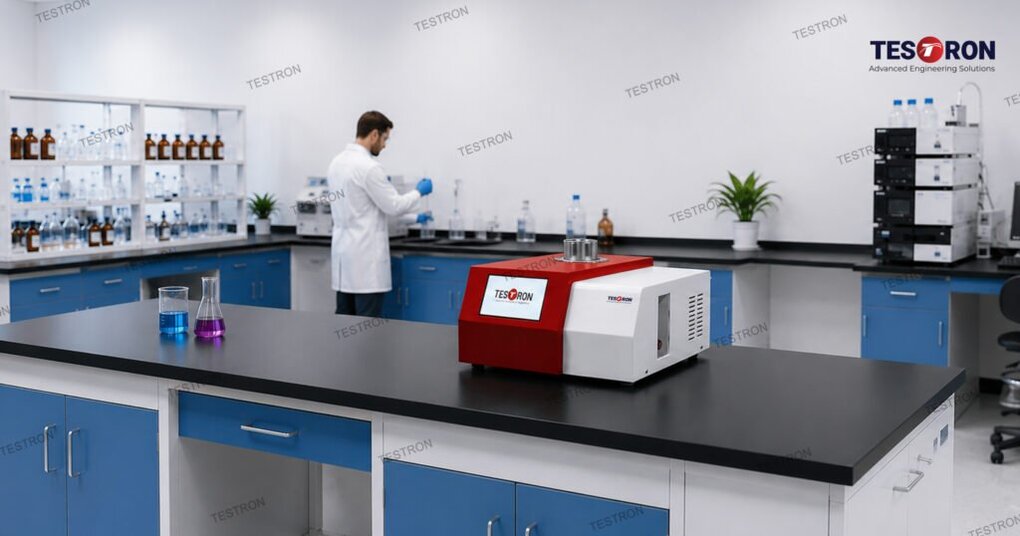
This blog compares essential hardware specifications, baseline sensitivity, automated gas switching, and ASTM standards across top models of DSC Differential Scanning Calorimeter in the USA. Also, it assists American laboratories in picking a high-precision testing solution that guarantees exceptional long-term ROI in 2026.
Looking to upgrade your lab’s thermal analysis setup? Request a live, personalized instrument demo with our experts!
Navigating the 2026 Thermal Analysis Landscape: Selecting the Ultimate DSC for Your Laboratory
Modern and existing labs are more curious about the ongoing precision trend in material testing divisions. That’s why they always invest in the best equipment that has high ROI and lots of advanced features at the best pricing.
Choosing the right dsc differential scanning calorimeter in the USA determines the accuracy of your thermal profile data and overall operational ROI. Then comes Testron’s differential scanning calorimetry machine.
The addition of this device aids many lab operators and researchers in boosting their sample scanning and precision. This instrument seamlessly bridges standard compliance with user-friendly operation by using its three advanced features, such as:
- Multi-Sensor Feedback
- Digital Mass-Flow Gas Switching
- Automated Software Workflows
Ready to boost your testing throughput? Explore our top-rated DSC thermal analyzers and request your brochure now!
Understanding Thermal Analysis: The Core Mechanism
Understanding the Dsc differential scanning calorimeter principle is essential when evaluating testing systems based on their cost and performance.
The core of the Dsc differential scanning calorimeter working principle relies on monitoring the energy differential required to maintain both a sample pan and an inert reference pan at identical temperatures.
This dynamic heating or cooling rate reveals precise physical and chemical changes within the material matrix.
A physical phase change or chemical transformation causes the sample to absorb or release heat energy. A modern Differential Scanning Calorimetry instrument captures these energetic shifts with extreme accuracy:
- Endothermic Reactions (Heat Absorption)
- Exothermic Reactions (Heat Release)
- Enthalpy Calculation
It’s important for engineers to understand how a differential scanning calorimetry machine captures these subtle changes. This proactive screening dramatically reduces factory scrap rates, prevents costly product recalls, and guarantees safety in mass production.
Ready to unlock ultra-precise thermal insights for your testing lab? Connect with our consultants now!
Key Features to Compare in 2026 Before Purchasing
Laboratory managers must compare technical specifications before investing on the right differential scanning calorimetry equipment. Let’s verify the important factors first:
- Furnace Architecture and Temperature Range
- Baseline Sensitivity and Noise Reduction
- User Interface and Embedded Control Systems
- Digital Mass Flow Gas Controllers (MFC)
- Software Automation and LIMS Connectivity
All these features are easily achievable with a highly efficient rate when you go with Testron’s Differential Scanning calorimetry instrumentation. This one move can keep you out of complex hardware setups and save more time analyzing critical quality data.
Industry Compliance & Standards: ISO, ASTM, and OIT Testing
A high-quality differential scanning calorimetry instrumentation suite must strictly adhere to internationally recognized standard testing frameworks.
For American laboratories, standard compliance is non-negotiable. That’s why Testron designed this pipe testing machine that complies with the given standards:
Standard | Objective | Usefulness |
ISO 11357 | Melting & Crystallization | Establishes standard procedures for measuring fusion enthalpies, melting points, and crystallization kinetics of synthetic polymers. |
| OIT | Oxidation Induction Time | Defines standard routines for assessing thermo-oxidative stability of polyolefin resins, particularly high-density polyethylene (HDPE) used in industrial infrastructure. |
Working with a certified material testing equipment supplier is always a great move. Testron provides the right device that eliminates manual timing errors and guarantees fully compliant, audit-ready testing results every single time.
Unsure about the ASTM/ISO protocols? Speak with our compliance specialists now!
Comparing Testron Group’s Flagship Models: Pricing, Ownership Costs, and ROI Factors
As a leading global dsc differential scanning calorimeter manufacturer, Testron Group offers two specialized models: a compact model and the high-precision ‘TT-DSC300’.
Let’s understand what the best option is to choose in 2026 for your US-based labs:
| Feature / Parameter | Compact Intelligent DSC Unit | TT-DSC300 High-Precision Model |
| Temperature Range | Room Temp to 500℃ | Room Temp to 600 ℃ |
| Temperature Resolution | 0.1℃ | 0.001℃ |
| DSC Sensitivity | 0.1 mW | 0.001mW |
| DSC Dynamic Range | 0 to ± 200 mW | 0 to ± 1000 mW |
| User Interface | Industry PC / CNC Digital Panel | 7-Inch 24-Bit Color Touchscreen |
| Primary Focus | OIT, Polymers, QC & Education | Advanced Kinetics, Curing, Full R&D |
| Targeted Applications | Useful across pipe manufacturing plants, incoming raw material verification, educational university laboratories, and routine polyolefin quality control. | Vastly popular for Advanced thermoset curing studies, kinetic reaction modeling, and pharmaceutical polymorph analysis. |
The compact Differential Scanning Calorimetry instrument is an intelligent, space-saving unit from Testron. However, the TT-DSC300 represents the pinnacle of thermal analytical performance.
Also, understanding the full financial picture of a dsc differential scanning calorimeter price structure ensures your laboratory secures a solution that delivers maximum return on investment.
Key economic factors influencing overall ownership cost include:
- Calibration & Preventive Maintenance
- Initial Hardware & Software Capital Expenditure
- Energy Consumption & Operational Uptime
- Consumables and Sample Pan Costs
Searching for the right balance for your modern lab? Request an instant, personalized line-item quotation from Testron’s experts now!
Conclusion
The right selection of the dsc differential scanning calorimeter in the USA in 2026 can make a huge difference for industrial and academic labs. A finest upgrade can provide reliable hardware architecture, intelligent software automation, and proven standards compliance.
Let’s be part of the right and a material testing equipment supplier and thermal analysis expert. Join Testron and empower your lab to achieve repeatable results day after day.
FAQs
- Temperature range
- Baseline sensitivity
- Mass flow gas automation
- Software capabilities
Get your customized price from Testron now!